
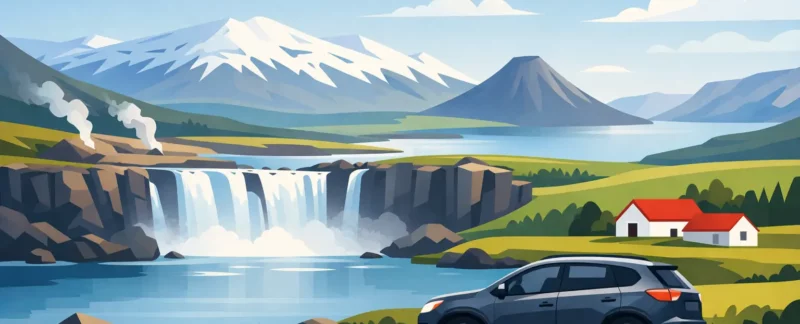
A good family day trip from Akureyri is not about cramming in every famous stop before dinner. It is about giving children room to get curious, giving adults time to look around, and choosing a route that still feels manageable when the weather changes or somebody needs a snack break.
North Iceland is especially well suited to this kind of day. Within a reasonable drive of Akureyri, families can stand beside a broad waterfall, walk through lava formations, watch steam rise from the earth, and see a landscape that feels very different from one stop to the next. The trick is choosing fewer places and experiencing them properly.
Start With the Right Pace
Families often ask whether they should see Lake Mývatn, Goðafoss, and the Diamond Circle in one day. The honest answer is that it depends on the ages, interests, and energy levels in the group. A long scenic drive may be a pleasure for a teenager interested in photography, but a tiring day for a preschooler. The same applies to walks. A short trail with an exciting destination usually works better than a demanding hike with a nice view at the end.
For most families, the best plan from Akureyri is a relaxed day toward Goðafoss and the Lake Mývatn area. This route has plenty of variety without requiring everyone to spend the whole day in the vehicle. It also gives you options. If the weather is clear, you may want to spend more time outdoors. If wind or rain arrives, the route can be adjusted around shorter walks, sheltered viewpoints, and warm stops.
A private guide is particularly useful here because a family itinerary should not run on a rigid clock. Children notice when adults are rushing, and Icelandic weather does not care about a printed schedule.
A Family-Friendly Route From Akureyri
Goðafoss: A Big Waterfall With an Easy Reward
Goðafoss is a natural first stop when traveling east from Akureyri. It is close enough to feel like the day has begun quickly, which matters with younger travelers. The waterfall is wide, powerful, and easy to appreciate without a long walk.
There are viewing areas on both sides of the river, but conditions can help determine which one makes the most sense. Paths may be icy in winter, wet after rain, or uneven for a stroller. In those cases, it is better to choose the safest viewpoint and take your time than to try to cover every angle.
This is also a good place to tell a little history. Goðafoss is often called the Waterfall of the Gods because of its connection to Iceland’s conversion to Christianity around the year 1000. For children, that story can be more memorable than a date on a sign: an old law speaker, a major decision, and statues said to have been thrown into the rushing water.
Lake Mývatn: Lava, Birds, and Space to Explore
From Goðafoss, the landscape changes as you approach Lake Mývatn. This is one of Iceland’s most remarkable volcanic regions, but it does not need to be explained like a geology lecture. Children can see what volcanic activity has made: strange lava fields, pseudocraters, steaming ground, and a shallow lake known for birdlife in the warmer months.
Dimmuborgir is often a strong choice for families. Its lava formations create a maze-like setting where a short walk can feel like an adventure. There are trails of different lengths, so the visit can be kept simple or extended if everyone is enjoying it. The ground is natural and uneven in places, so sturdy shoes are more useful than trying to make the day look polished in photos.
Höfði is another gentle option when conditions are suitable. The small peninsula has distinctive lava pillars along the lake and a quieter feel than some of the more dramatic stops. It can be a welcome change of pace after larger sights.
Námaskarð: Let the Ground Do Something Unexpected
The geothermal area at Námaskarð is one of those places that makes even a short stop feel worthwhile. Steam escapes from the ground, mud bubbles, and the colors range from ocher and rust to pale gray. It is exciting, a little strange, and very clearly not a playground.
Families should keep children close and remain on marked paths. The ground and steam are hot, and geothermal areas deserve respect. Still, with good guidance and clear boundaries, this can be one of the stops children remember most. It is a useful reminder that Iceland is not simply scenic. It is active beneath your feet.
Build in Breaks Before You Need Them
The difference between a pleasant outing and a difficult one is often not the destination. It is timing. Eat before people become hungry, use a restroom when one is available, and stop while children are still interested rather than waiting until they are worn out.
Bring layers for every member of the family, including adults who think they will be fine in a light jacket. North Iceland can feel mild at one stop and sharply windy at the next. Waterproof outer layers, hats, gloves, comfortable walking shoes, water, and easy snacks cover most situations. Sunglasses can be surprisingly helpful too, especially around snow, water, or low northern light.
If you are traveling with a baby or toddler, think carefully about access. Not every viewpoint is stroller-friendly, and a carrier can make some sites much easier. With school-age children, letting them choose between two appropriate stops can help the day feel like their adventure as well.
What Changes With the Season
Summer gives families long daylight, greener trails, and more time to explore at an unhurried pace. It is ideal for birdwatching around Lake Mývatn and for combining several outdoor stops. Even then, insects can be present around the lake, especially on still days, so a head net may be worth considering for sensitive travelers.
Winter can be beautiful and much quieter, but it calls for a more flexible plan. Snow, ice, wind, and shorter daylight affect driving and walking conditions. A winter day may focus on fewer places, chosen carefully according to road conditions and the weather forecast. The reward can be extraordinary light, frozen waterfalls, and, if circumstances line up, the possibility of seeing the Northern Lights later in the evening.
Spring and fall sit somewhere in between. They can offer peaceful roads and changing colors, but they are also seasons when weather can shift quickly. A local guide can make practical decisions as the day develops rather than treating flexibility as an afterthought.
Why Private Guiding Helps Families
Driving in North Iceland is often straightforward in good conditions, but visitors should not underestimate distances, wind, winter roads, or the concentration required when everyone in the car wants something at once. Being driven lets parents look out the window, answer questions, and enjoy the trip rather than managing every turn and forecast update.
A private day also creates room for the small things that large tours cannot easily accommodate: an extra photo stop, a slower walk, a child who needs a break, or a change of plan because the clouds have closed in over one area. At Kip, the goal is not to move families through a checklist. It is to shape a day around what makes the region meaningful and comfortable for the people actually traveling.
Let the Day Leave Room for Wonder
The strongest family memories are rarely the moments that were planned down to the minute. They are the child spotting steam for the first time, the quiet after a waterfall stops roaring in your ears, or the shared laugh when the wind reminds everyone that Iceland is very much in charge.
Choose a route with variety, keep expectations realistic, and leave a little empty space in the schedule. That is often where a family day in North Iceland becomes a story people keep telling long after the trip is over.