
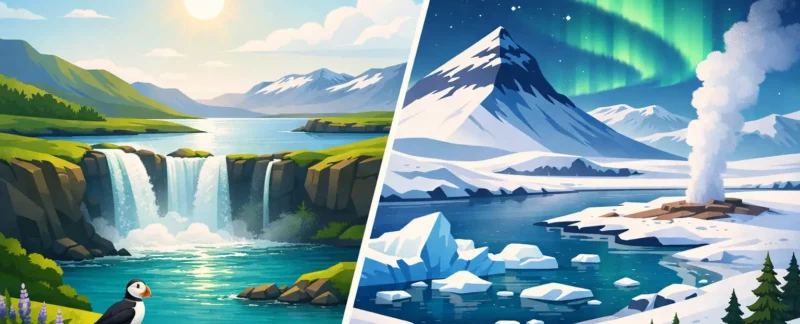
At Lake Mývatn in June, the evening can feel like it has forgotten to arrive. In January, that same landscape may be blue with snow beneath a short, soft day. Choosing summer or winter in North Iceland is not simply a question of temperature. It changes what roads are possible, how long you can be outdoors, which landscapes you can reach, and what kind of memories you bring home.
Neither season is automatically better. Summer gives you distance, daylight, and access. Winter gives you atmosphere, snow-covered geology, and a real chance to see the Northern Lights. The right choice depends on whether you want to cover ground, take photographs in dramatic conditions, travel with children or older family members, or slow down and let the weather set the pace.
Choosing Summer or Winter in North Iceland
North Iceland is a large region with a lot of variety. The gentle green around Eyjafjörður, the volcanic country around Mývatn, the waterfalls of the Diamond Circle, and the remote highlands do not behave the same way across the year. A good itinerary starts with your priorities, then respects the season rather than fighting it.
Summer usually means late May through September, with the longest days around June and July. Winter travel is generally most reliable from late October into March, though snow and ice can arrive earlier and remain later. April, May, September, and October sit in between, offering their own advantages and a little more uncertainty.
Summer is for long days and wider access
If your wish list includes Askja, mountain roads, long scenic drives, nesting birdlife, or a full day combining several distant sights, summer is usually the sensible choice. The highland routes open only after the snow has melted and the ground has dried enough to handle traffic. Their opening dates vary every year, so a planned summer trip still needs flexibility.
The midnight sun is more useful than it sounds on paper. You are not limited to a narrow sightseeing window. A waterfall can be quiet at 9 p.m., a walk can happen after dinner, and photographers can work in low, warm-looking light without waking at an unreasonable hour. Families often appreciate this too, because a private day can move at a comfortable pace with time for breaks rather than rushing from one stop to the next.
Summer also makes the volcanic landscapes easier to read. At Hverir, steam rises from bare earth in shades of ocher and rust. Around Mývatn, green vegetation, lava formations, and bright water create a very different scene from the winter palette. Puffins and other summer birdlife may be part of a coastal route, while the valleys are at their most open and inviting for walking.
There are trade-offs. The most famous stops can be busier in July and August, especially in the middle of the day. Around Lake Mývatn, small insects can be persistent on warm, still days. Summer weather is also Icelandic weather: rain, wind, and sudden low cloud are possible even when the forecast looked promising the night before. Bring layers and waterproof outer clothing, not just a light jacket because the calendar says July.
Winter is for snow, stillness, and dark skies
Winter in North Iceland has a special clarity. Snow simplifies the view, dark lava turns graphic against white fields, and frozen edges form around waterfalls and streams. On a clear night away from town lights, the sky can become the main event.
The Northern Lights are a reason many visitors choose winter, but they should never be treated as guaranteed. You need darkness, a sufficiently active aurora, and clear or partly clear sky in the right place at the right time. The weather often decides the evening. A flexible private plan is valuable here because it allows the route to respond to cloud cover rather than following a fixed schedule.
Daylight is short from November through January. That does not mean there is nothing to do. It means you should plan differently. A well-paced day might focus on a few excellent places – a waterfall, geothermal area, scenic lake view, and local stop – instead of trying to tick off every landmark. The low winter sun can be beautiful for photography, but it appears briefly and often stays behind cloud, so patience is part of the experience.
Road travel requires more care in winter. Main routes and key roads are maintained, but conditions can change quickly with wind, drifting snow, freezing rain, or poor visibility. Remote roads and highland routes are closed. Visitors who are not used to driving on ice often enjoy winter far more when someone else handles the conditions and the route decisions. It leaves you free to look out the window instead of watching every patch of road.
Winter is not always brutally cold. Coastal North Iceland can be milder than many American visitors expect, though wind makes a major difference. Warm base layers, insulated outer layers, gloves, a hat, and sturdy waterproof boots matter more than bringing one enormous coat. The ground can be icy even on a calm, clear day.
The Shoulder Seasons Offer a Different Kind of Trip
September and October can be especially appealing for travelers who want autumn color, fewer visitors, and the possibility of dark enough skies for Northern Lights viewing. There is still reasonable daylight in September, though the highlands begin to close as conditions change. By October, winter driving conditions are increasingly possible.
April and May are seasons of transition. Snow can remain in the hills while roads are opening and days become much longer. Waterfalls are powerful with meltwater, migratory birds return, and the landscape feels as if it is waking up. These months can offer a quieter trip, but they reward travelers who are happy to adapt. A route that works beautifully one week may be difficult the next because of snow, wind, or road conditions.
If a particular place is the heart of your trip, choose the season around it. For Askja and deep highland landscapes, aim for the established summer road season. For aurora hunting and snowy scenes around Mývatn, choose winter. For a broad mix of driving, waterfalls, and daylight without peak summer crowds, early fall or late spring can be an excellent compromise.
Match the Season to Your Travel Style
Couples planning a photography-focused trip often have a clear choice. Summer offers expansive access, long shooting windows, and colorful landscapes. Winter offers stronger contrast, changing light, and the possibility of aurora images. If photography is the priority, it is worth building extra time into the itinerary for weather rather than trying to force a long list of stops.
Families and multigenerational groups often find summer easier because days are long, roads are generally simpler, and there are more options if someone needs a slower pace. That said, a winter day can be wonderful for a family that prefers a few memorable experiences over constant movement. A snow-covered waterfall, geothermal steam, and a warm break can be more enjoyable than an ambitious drive.
Independent travelers sometimes choose summer because they want maximum freedom, while winter appeals to those looking for a quieter and more dramatic Iceland. Both can work well. The key is being honest about comfort with changing weather and road conditions. North Iceland rewards curiosity, but it does not reward a rigid plan.
Let Local Conditions Shape the Day
The best season is the one that fits your expectations, but the best day is the one that responds to the actual conditions. A clear winter evening may shift the focus toward the sky. Heavy summer rain may make waterfalls extraordinary while hiding a mountain view. Knowing an alternate valley, a sheltered stop, or the right direction to drive can make the difference between a disappointing forecast and a memorable day.
That is the value of traveling with a local guide on a private tour. At Kip, each day can be adjusted to the group, the weather, road conditions, and what interests you most – geology, stories, quiet landscapes, photography, or simply a comfortable way to see more of the region.
Come in summer if you want North Iceland to feel open and endless. Come in winter if you want it to feel intimate, elemental, and a little mysterious. Either way, leave room in your plans for the weather to surprise you. In this part of Iceland, that is often when the best moments happen.