
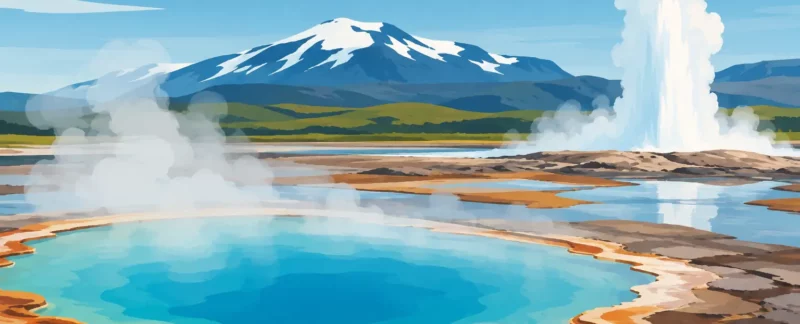
Steam rising from a bare hillside is one of the clearest signs that Iceland is still being made beneath your feet. When people ask about the best geothermal sites Iceland offers, they often picture a famous erupting geyser. That is certainly part of the story, but the country’s geothermal landscapes are much broader: boiling mud pools, sulfur-stained earth, lava fields that still hold heat, and quiet hot springs far from the main roads.
For travelers in the north, geothermal areas around Lake Mývatn and Krafla offer some of the most dramatic and accessible examples. A few sites are easy stops on a day trip; others require a proper highland vehicle, good conditions, and time. Here are ten places worth planning around, with a little local perspective on what makes each one different.
1. Hverir at Námafjall
Just east of Lake Mývatn, Hverir is a raw, unforgettable geothermal field beneath Námafjall mountain. Mud pots bubble like thick gray paint, steam vents roar from the ground, and the soil ranges from ochre to deep rust red. The sulfur smell is strong, but that is part of the experience.
It is one of the most photogenic and straightforward geothermal stops in North Iceland, especially in low morning light or under a fresh dusting of snow. Stay on the marked paths. The ground is hot, unstable, and much more delicate than it looks. Hverir is a place to walk slowly, not rush through between photos.
2. Leirhnjúkur and the Krafla Lava Fields
A short drive from Hverir, Leirhnjúkur shows a younger and wilder side of Icelandic geothermal activity. The area was shaped by the Krafla Fires, a volcanic episode that lasted from 1975 to 1984. You can walk across black lava fields, past steaming cracks, and along ground that is still warm in places.
The walk is not difficult in good summer conditions, but it is uneven and can be icy or snow-covered outside the main season. Leirhnjúkur rewards travelers who want more than a roadside viewpoint. The scale of the lava, the color in the mineral deposits, and the quiet sound of steam escaping the earth make it feel wonderfully close to Iceland’s volcanic core.
3. Víti Crater at Krafla
Víti, meaning “hell,” is a striking explosion crater near the Krafla power station. Its blue-green water is framed by dark volcanic slopes, creating one of those Icelandic scenes that looks edited even when it is not.
The short path around the rim is usually the main attraction, though snow and wind can change conditions quickly. Do not confuse this Víti with the larger crater lake at Askja. Both are remarkable, but Krafla’s Víti is far easier to reach and fits naturally into a day exploring the Mývatn area.
4. Mývatn Nature Baths
Not every geothermal experience needs to involve wind, sulfur fumes, and muddy boots. The Mývatn Nature Baths offer warm, mineral-rich water with broad views across Lake Mývatn and the surrounding volcanic landscape. It is a good place to slow down after walking at Hverir or Leirhnjúkur.
This is a developed bathing site rather than a wild spring, which makes it a comfortable choice for families, couples, and travelers visiting in colder weather. An evening soak can be especially pleasant in winter, when the air is sharp and there is a chance of northern lights overhead. Visibility is never guaranteed, of course, but the view is good even without them.
5. Geysir and Strokkur
In southwest Iceland, the Geysir geothermal area remains one of the country’s essential geothermal stops. The original Great Geysir is usually quiet, but nearby Strokkur erupts frequently, shooting hot water high into the air every few minutes.
It can be busy, particularly in summer, but it earns its popularity. The active pool, the surrounding steam vents, and the wide open landscape give first-time visitors a clear introduction to the force beneath Iceland’s surface. Arriving early or later in the day makes the experience more peaceful.
6. Deildartunguhver
Deildartunguhver in West Iceland does not have the drama of a geyser eruption, but it is a remarkable example of geothermal power used in daily life. It is Europe’s highest-flow hot spring, and its hot water helps heat homes in towns many miles away.
The spring itself is viewed from a safe platform. The water is extremely hot, so this is not a place for swimming or testing the temperature with a hand. It is, however, a useful reminder that geothermal energy is not just scenery in Iceland. It is part of how communities live.
7. Gunnuhver on Reykjanes Peninsula
Gunnuhver is a steaming, hissing geothermal field near the southwestern coast. Boardwalks lead visitors between powerful steam vents and boiling mud pools, with the Atlantic and Reykjanes lighthouse close by.
The area has changed over the years because geothermal systems are active by nature. That is worth remembering anywhere in Iceland: a trail, pool, or viewing area may be closed for safety, and conditions are never fixed. Gunnuhver is especially worthwhile for travelers arriving or departing through Keflavík who want a first or final taste of volcanic Iceland.
8. Seltún at Krýsuvík
Also on Reykjanes Peninsula, Seltún is smaller and more colorful than Gunnuhver. Its wooden paths pass bright yellow sulfur deposits, bubbling pools, and pale blue-gray clay. It is a fine choice for travelers who enjoy geology, photography, or a shorter walk with plenty to look at.
Seltún and Gunnuhver work well together, but they have different moods. Seltún feels intimate and colorful; Gunnuhver feels louder and more exposed. If time allows, visit both rather than choosing one as a substitute for the other.
9. Kerlingarfjöll and Hveradalir
For many experienced travelers, Hveradalir in the Kerlingarfjöll mountains belongs near the top of any list of the best geothermal sites in Iceland. The name means “Valley of Hot Springs,” and the landscape is extraordinary: steaming hillsides, orange rhyolite, snow patches, and mountain trails above the highlands.
It is also a destination where logistics matter. Access depends on the season, road conditions, and the vehicle you are using. The highland roads are not ordinary scenic drives, and river crossings may be involved on some routes. A guided trip or a carefully planned visit is sensible if you are not comfortable driving in remote Icelandic conditions.
10. Askja and Víti in the Central Highlands
Askja is not a casual stop, but it is one of Iceland’s great volcanic destinations. The enormous caldera, the dark desert surroundings, and the vivid blue water in Víti crater make the journey feel like travel to another planet. Geothermal heat is part of the landscape here, though the main draw is the volcanic scale rather than a dense field of mud pots.
Askja requires a full day from North Iceland and is generally a summer destination. Roads can open late, weather can turn quickly, and the route is rough. For travelers with limited time, Mývatn gives a much easier geothermal day. For those who want remoteness, highland scenery, and a true sense of distance, Askja is hard to match.
How to Visit Geothermal Areas Safely
The most useful rule is also the simplest: marked paths are there for a reason. Geothermal crust can be thin, steam can contain unpleasant or dangerous gases, and water that looks calm may be close to boiling. Keep children close, respect closures, and do not enter natural pools unless bathing is clearly permitted.
Weather deserves equal respect. In the Mývatn region, conditions can shift from clear skies to strong wind or snow within a short time. Good footwear, warm layers, and a flexible plan make a real difference. In winter, the easiest geothermal sites can still be rewarding, while remote highland destinations are generally out of reach.
The best visits leave room for the unexpected: light moving over a steam field, a sudden quiet after a gust of wind, or the simple pleasure of warming up in a geothermal bath after a cold day outside. If you are exploring North Iceland and would rather focus on the landscape than road conditions and timing, a private day with a local guide can make it easier to follow the weather and find the right rhythm for the day.
