
Askja is not a place you casually add between breakfast and dinner. This Askja travel guide is for travelers who want to reach one of Iceland’s most remarkable volcanic landscapes with enough time, the right vehicle, and a healthy respect for the highlands.
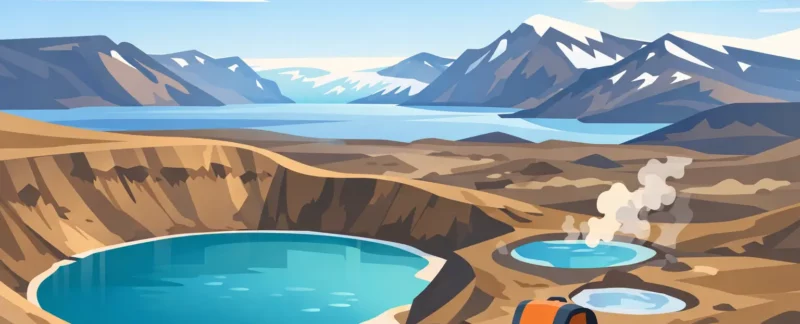
The reward is extraordinary: a vast caldera shaped by eruptions, dark lava fields stretching toward distant mountains, and the blue-green water of Víti crater beside the much larger Lake Öskjuvatn. It feels remote because it is remote. A day here is about the journey as much as the destination.
Why Askja takes more planning than most day trips
Askja sits deep in Iceland’s central highlands, roughly 1,100 meters above sea level. Even in summer, weather can shift from bright sun to cold wind, low cloud, rain, or sleet in a short time. The landscape is open and beautiful, but there are few services, no casual roadside stops, and long distances between reliable help.
For travelers based near Lake Mývatn, Laugar, or Akureyri, Askja is usually a full-day commitment. Driving times depend heavily on the chosen route, road conditions, river levels, and how often you stop. It is wise to leave early and keep the rest of the evening flexible.
This is also one of those places where a map can be misleading. A road may look like a simple line across the interior, but an F-road can include rough lava tracks, washboard surfaces, blind rises, and unbridged rivers. The shortest route is not automatically the best route for your vehicle or your confidence.
Askja travel guide: choosing the right route
The most common approaches use mountain roads such as F88, F905, and F910. Which route is suitable changes through the season and sometimes from one day to the next. Road openings are typically summer-only, and an open road does not mean every river crossing is easy or appropriate for every driver.
F88 is often the more direct approach from the northeast, but it has river crossings that can be serious. Water levels rise with warm weather, rain, and snowmelt, and the character of a crossing can change quickly. It is not sensible to follow another vehicle blindly. That vehicle may have greater clearance, a more experienced driver, or simply better luck.
Routes via F905 and F910 can sometimes offer an alternative, but they are still highland roads, not regular paved highways. Conditions vary, and route choice should be based on current information, vehicle capability, group comfort, and the weather forecast. A proper 4×4 with good ground clearance is essential for highland driving. Standard rental cars are not built for these roads, and rental agreements often restrict where they may be driven.
If you have little experience with river crossings, the practical choice is usually to travel with a qualified local guide rather than turn the day into a driving test. It gives you more time to enjoy the scenery, and it removes the pressure of making a difficult decision in the middle of a cold river.
Check conditions on the morning of travel
Do not rely only on a road report you saw days earlier. Before setting out, check the latest official road conditions, weather forecast, alerts, and any notices affecting the highland routes. Ask specifically about river conditions if you are planning a route with crossings.
A good plan has room to change. If visibility is poor, water levels are high, or a road closes, postponing Askja is not a failed day. Iceland’s highlands will still be there. Pushing ahead when conditions are wrong is how a memorable trip becomes an expensive and stressful one.
What the Askja hike is really like
Most visitors park at Vikraborgir and walk across the volcanic landscape toward the crater area. The usual trail to Víti is around 1.5 miles each way, though the time needed depends on wind, snow patches, ground conditions, and how often you stop to look around. Plan on roughly one to one and a half hours each way at an unhurried pace.
The route is not technically difficult in good conditions, but it is exposed. Wind can be strong enough to make the walk feel much longer, and fog can erase the sense of direction that the wide open terrain normally provides. Sturdy waterproof hiking boots are much more useful than fashionable sneakers here. Bring warm layers, a waterproof outer shell, gloves, and a hat even if the forecast at lower elevations looks pleasant.
At the end of the path, Víti is the small explosion crater with mineral-colored water. Lake Öskjuvatn, formed during the great 1875 eruption, lies nearby in the enormous Askja caldera. The scale is hard to understand from photographs. This is an active volcanic region, but activity does not mean there is a daily spectacle. The appeal is the geology written plainly across the ground: ash, lava, craters, faults, and a landscape still being shaped by heat beneath it.
Swimming in Víti has been popular at times, but it should never be treated as a guaranteed activity. Water temperature, access, trail stability, weather, and safety conditions vary. The descent can be steep and slippery, and the water may not be as warm as people expect. Enjoy the view first, then make a sensible decision based on the conditions in front of you.
Pack for distance, cold, and delays
The highlands reward people who prepare for the boring possibilities. Bring more water and food than you think you will need, especially if you have dietary requirements. There are no dependable cafes or stores waiting at the end of the route.
Your day bag should include warm insulating layers, rain gear, hiking boots, gloves, a hat, sunglasses, sunscreen, a charged phone, and a power bank. A small first-aid kit and any essential medication belong in the vehicle, not back at your accommodation. For photography, keep batteries warm in an inside pocket and protect camera gear from windblown dust and rain.
Fuel is equally important. Start with a full tank and know your range before leaving the last fuel stop. Highland driving uses more fuel than many visitors expect, particularly on rough surfaces. Keep an eye on the weather as well as the clock. The return drive is long, and fatigue can make rough roads feel rougher.
Give Askja the time it deserves
Askja works best for travelers who are comfortable with uncertainty. On a clear day, the ride through the Ódáðahraun lava desert and the walk into the caldera can be one of the great experiences of a North Iceland trip. On a wet, cloudy day, it can still be powerful, but it calls for more patience and better clothing.
Private guiding is especially useful here because the day can be shaped around your group. A photographer may want extra time on the lava fields and at quieter viewpoints. A family may prefer a slower pace and more frequent stops. Travelers who do not want to drive F-roads can simply look out the window, ask questions, and arrive with energy left for the hike. With Kip, that local flexibility is part of the experience, not an add-on.
Askja is not about ticking off another famous Icelandic sight. It is about standing in a place where the road ends, the wind carries across black sand, and the earth makes its own rules. Pack well, stay flexible, and let the conditions set the pace.
