
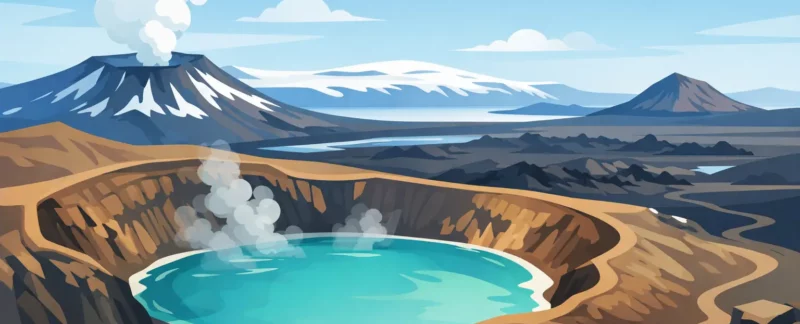
If Askja is on your Iceland wish list, you are probably already looking at maps, mountain roads, and weather pages and wondering the same thing: do you need a guide for Askja? The honest answer is not always, but very often, yes. Askja is one of those places where the difference between a good plan and a bad one is not small. It can mean the difference between a memorable highland day and a long, stressful one.
Askja is remote even by Icelandic standards. That is part of the appeal. The landscape feels stripped back and volcanic, with wide open desert, old lava, sudden water, and very little around you. It is also exactly why this trip deserves more thought than a standard scenic drive.
Do you need a guide for Askja, or can you self-drive?
You can self-drive to Askja in the right season if you have the right vehicle, real experience on rough highland roads, and enough judgment to turn around when conditions are not right. That is the key point many visitors miss. The question is not just whether the route is technically possible. The better question is whether it is sensible for your group, your comfort level, and the conditions on that day.
A lot of travelers picture Icelandic roads as challenging but manageable with enough confidence. Askja is different. This is not a scenic paved route with a few potholes. Access depends on mountain roads that can be rough, slow, and tiring. Road openings are seasonal. Conditions can shift fast. River crossings may be part of the route depending on where you go and when.
For some travelers, that is part of the adventure. For others, it becomes several hours of white-knuckle driving before they even reach the trailhead. If your goal is to enjoy the place rather than prove you can get there on your own, a guide often makes far more sense.
What makes Askja different from other day trips?
Askja sits deep in the highlands, in a volcanic area shaped by eruptions, ash, lava fields, and powerful geological forces. It feels wild because it is wild. Services are limited. Distances are long. If something changes, whether that is weather, visibility, road condition, or your energy level, there are fewer easy fixes than on more accessible routes.
That matters especially for first-time visitors to Iceland. Many people are excellent drivers at home and still find the highlands unfamiliar. Gravel handling, washboard surfaces, blind rises, isolated stretches, and water crossings are not everyday driving for most US visitors. Add fog or rain, and confidence can disappear quickly.
Then there is the simple issue of time. An Askja day is long. Even when everything goes smoothly, it is rarely a casual outing. A private guided trip lets you spend your attention on the landscape, the geology, and the experience itself instead of constantly calculating fuel, road stress, and whether that next section looks worse than the last one.
The road is often the real deciding factor
When people ask whether they need a guide for Askja, they are often really asking whether they want to deal with the road. That is fair. The destination gets all the attention, but the journey is a major part of the day.
Some travelers genuinely enjoy remote driving and come prepared for it. If that is you, and you understand highland conditions well, self-driving may be a reasonable choice. But many visitors underestimate how tiring rough roads can be over several hours. You arrive at the trailhead already worn out, then still need to hike, stay alert, and make the return journey.
A guide removes that burden. Just as important, a local guide reads the day better. That includes road conditions, pacing, weather shifts, and how to adapt if the original plan needs to change.
When a guide makes the most sense
If you are on the fence, think less about courage and more about fit. A guide is especially worthwhile if you are visiting Iceland for the first time, traveling as a couple where only one person wants to handle difficult driving, bringing children, traveling with older family members, or hoping for a photography-focused day without rushing. It also makes sense if you simply prefer having local context rather than reaching a dramatic place and only knowing what you read the night before.
Askja is not only about reaching a crater. The area tells a larger story about Iceland itself – volcanic systems, remote settlement history, changing routes through the interior, and the scale of the highlands. With the right guide, the day becomes more than transportation to a viewpoint.
This is also where private travel helps. Not every group wants the same pace. Some want to walk more. Some want more stops for photos. Some want a quieter day with less hiking and more interpretation along the way. That flexibility matters on a long excursion.
Safety is not the same as fear
Hiring a guide for Askja does not mean the trip is dangerous in a dramatic way. It means you respect where you are going. Iceland rewards independence, but it also rewards realism.
A good local guide brings more than driving skill. They bring route knowledge, weather judgment, vehicle experience, and the ability to make calm decisions if conditions change. That is especially valuable in areas where small problems can become time-consuming ones.
For many travelers, the best part is peace of mind. You do not have to second-guess every turnoff or wonder whether your map matches the road in front of you. You can look out the window and actually be there.
What you gain from a guided Askja tour
The practical gain is obvious: someone else handles the difficult logistics. But the more lasting value is often in the details. A local guide can explain what you are seeing in plain language, not as a geology lecture unless you want one. Why does this landscape look so barren in one area and layered in another? Why is the color of the ground changing? What happened here, and how does it connect to the rest of the region?
That kind of context changes the day. Remote places can feel abstract without it. With it, the landscape becomes readable.
There is also the matter of comfort. A well-planned private day means proper pacing, suitable stops, and a vehicle chosen for the route rather than simply whatever was available at the rental desk. For travelers staying in or around North Iceland, that can make Askja feel possible when self-driving would feel like too much.
In a business like Kip, that local layer matters. When your guide is not just driving a route but knows the wider region through lived experience, the day tends to feel less scripted and more grounded.
When self-driving may still be the right call
Not everyone needs a guide, and it is worth saying that clearly. If you have a suitable 4×4, experience with rough mountain roads, a flexible schedule, and comfort with the limits of the highlands, self-driving can absolutely work. Some travelers prefer that independence and plan carefully enough to do it well.
The trade-off is that you need to own the whole day. That means checking road conditions properly, understanding what your insurance does and does not cover, bringing the right supplies, allowing for delays, and being willing to cancel if conditions are poor. Askja is not a place to force because you had one free day on the itinerary.
If that level of responsibility sounds manageable and enjoyable, self-driving might suit you. If it sounds like a lot to carry on a vacation, that is your answer too.
A better question to ask before you go
Instead of only asking, do you need a guide for Askja, ask this: how do you want the day to feel? If you want challenge, total independence, and the satisfaction of doing the route yourself, then self-driving may be part of the experience you are after. If you want to arrive relaxed, understand the place more deeply, and let someone with local judgment handle the hard parts, a guide is usually the better choice.
Askja is special because it still feels far away. That remoteness is the reason people dream about it, and also the reason many are happier visiting with help. There is no prize for making a long day harder than it needs to be. The best version of Askja is the one where you have enough energy left to stand still, look out across the volcanic landscape, and feel how quiet it really is.
