
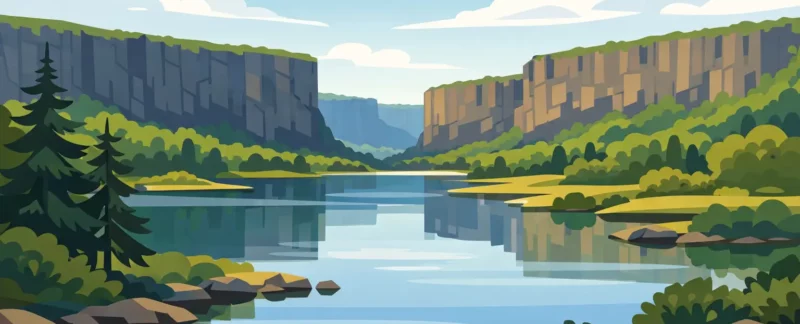
Ásbyrgi does not need a dramatic arrival to make an impression. You drive through open country in northeast Iceland, pass into a sheltered forest, and suddenly find yourself below steep horseshoe-shaped cliffs. If you are wondering how to visit Ásbyrgi Canyon, the best answer is simple: give it more time than a quick photo stop, and let the place set the pace.
The canyon is part of the Jökulsárgljúfur area of Vatnajökull National Park, near the northern end of the Diamond Circle. It is known for its unusual shape, quiet woodland, small lake, birdlife, and the sheer scale of the cliffs surrounding it. It is also a place where geology and old stories sit comfortably side by side. Local tradition says the canyon was made when Odin’s eight-legged horse, Sleipnir, placed one hoof on the earth. Geology tells a different but no less dramatic story of enormous glacial floods from the Jökulsá á Fjöllum river.
Start with the right amount of time
Ásbyrgi can work as a stop on a larger Diamond Circle route, but it should not be treated like a roadside waterfall where ten minutes is enough. Allow at least one and a half to two hours if you want to walk around Botnstjörn pond, take in the canyon walls, and visit the information area when it is open.
Three hours is better for travelers who enjoy easy hiking, photography, or simply sitting somewhere quiet. If you plan to combine Ásbyrgi with Dettifoss, Hljóðaklettar, and other stops in Jökulsárgljúfur, expect a full day. The distances on a map can look modest, but North Iceland roads, weather, walking time, and frequent photo stops all add up.
For many guests, Ásbyrgi is especially rewarding later in the day, when larger sightseeing routes have moved on and the lower light softens the canyon walls. That said, summer daylight is generous, so there is no need to race the clock.
How to visit Ásbyrgi Canyon by car
The main access is from Route 85, which runs along the northeast coast. Ásbyrgi is reachable from Húsavík, Mývatn, Akureyri, and the towns and villages of the northeast, though travel times vary greatly depending on your starting point and stops along the way.
Most visitors arrive at the developed entrance near the campground and visitor facilities. From there, the inner canyon is easy to explore on foot. The roads leading to the area are generally straightforward in summer, but Icelandic driving is never just about the road surface. Wind, fog, rain, sheep near the road, and changing visibility can all affect a day out.
Before leaving, check current road and weather conditions, especially outside the main summer season. A route that was comfortable in dry daylight can feel very different in strong wind, heavy rain, or early snow. Do not rely only on a navigation app, and do not assume that a road shown as open will suit every type of rental car or every driver’s confidence level.
If you are driving the Diamond Circle, be careful with your route choice around Dettifoss. The roads on the east and west sides of the river are not interchangeable in comfort or conditions. The rougher route is not always a pleasant surprise in a standard rental car, particularly after rain or early in the season. A sensible itinerary is usually more enjoyable than an ambitious one.
The best walks inside the canyon
Ásbyrgi has walks for different energy levels, which is one reason it works well for couples, families, and mixed-age private groups. You do not need to be a serious hiker to experience its character.
Walk to Botnstjörn pond
The walk around Botnstjörn, the small pond at the back of the canyon, is the natural starting point. It is relatively easy and gives you the classic Ásbyrgi atmosphere: birch and willow, birds moving through the trees, still water, and cliffs rising above the greenery.
This is a good choice if you have limited time, are traveling with children, or want a gentle walk after several hours in the car. The ground can be wet after rain, so waterproof footwear is useful even on an otherwise dry day.
Walk toward Eyjan
Eyjan, meaning “the island,” is the long rock formation that divides the canyon into two sections. Walking toward it gives a better sense of Ásbyrgi’s scale and shape. Some routes in this area are more uneven and can be muddier than the paths around the pond, but they are still manageable for many visitors with suitable footwear and a little patience.
This is also where it pays to slow down. Look closely at the layers in the cliffs, the vegetation sheltered by the canyon, and the difference between the exposed landscape outside and the greener world inside it. Ásbyrgi feels unexpectedly calm because it is protected from the wind that often moves freely across the surrounding plains.
Choose viewpoints only if conditions suit
There are longer hiking options and viewpoints above the canyon, but these are not automatically the best choice for every visitor. In wet weather, high wind, low cloud, or with limited daylight, a lower walk can be far more satisfying. A viewpoint is only worth it if you can safely enjoy it.
For photographers, the best images are not always from the highest point. Reflections on Botnstjörn, trees framed by cliffs, changing cloud shadows, and the texture of the canyon walls can be just as memorable. Bring a cloth for your lens and phone. Fine rain and wind-driven moisture have a way of appearing just when the light gets interesting.
What to bring and wear
Even in July, dress for a day that may include wind, showers, and a temperature change between the coast, the canyon, and higher ground. A waterproof outer layer, warm mid-layer, sturdy shoes, water, and a small snack will cover most situations. In summer, insect repellent can be worthwhile around still water. In colder months, traction aids may be useful, depending on the conditions.
Do not leave valuables visible in a parked car, and keep enough fuel for the full day. Services are limited compared with more populated parts of Iceland, and schedules can be seasonal. It is also wise to use restrooms and buy supplies when they are available rather than assuming the next stop will have them.
When is the best time to go?
Summer is the easiest season for most travelers. Trails are accessible, roads are usually at their most reliable, and the canyon is green and lively. It is the best time for families and anyone planning a relaxed day of walking.
Autumn brings richer colors and quieter paths, though weather becomes more variable and daylight shortens quickly. Winter can be beautiful, especially when snow highlights the canyon walls, but access and trail conditions require more preparation. Some facilities and routes operate on a reduced seasonal schedule. Spring can be equally changeable, with thawing ground, wind, and patchy snow.
The right season depends on what you value. For easy access and long walks, choose summer. For solitude and atmospheric light, consider the shoulder seasons, while allowing flexibility in your plans. For winter travel, local advice is particularly valuable because conditions can change faster than an itinerary.
Add Ásbyrgi to a day that makes sense
Ásbyrgi pairs naturally with Hljóðaklettar and the waterfalls of Jökulsárgljúfur, but trying to see every major stop in one day can turn a beautiful route into a checklist. If Dettifoss is your main priority, give yourself enough time there. If Ásbyrgi is the place you are most curious about, arrange the day so you arrive with energy left for a walk.
A private guided day can make this easier, particularly for travelers who would rather watch the landscape than calculate road conditions, parking, daylight, and driving time. On a day with Kip, the route can be shaped around your pace, mobility, interests, and the weather rather than a fixed bus schedule. That can mean a longer forest walk, a photography stop when the light changes, or skipping a windy viewpoint in favor of a quieter canyon trail.
Ásbyrgi rewards visitors who make room for small moments: the sound of birds in the trees, a break beside the pond, and the realization that this green shelter was shaped by forces far larger than it first appears. Leave a little unplanned time in your day, and the canyon will do the rest.
