
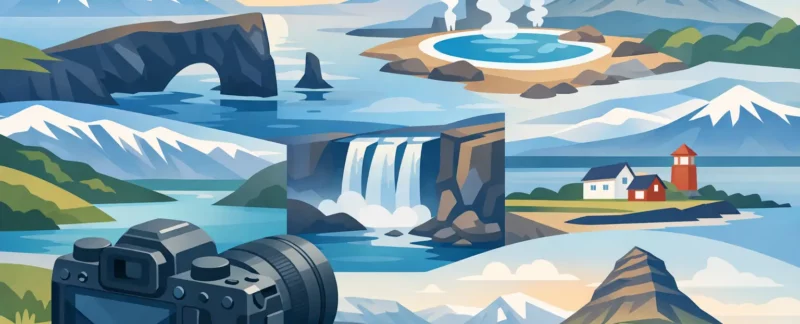
The best North Iceland photography spots are rarely about ticking off the most famous view before the next bus arrives. This region rewards patience: waiting for wind to settle on Lake Mývatn, returning to a waterfall when the light softens, or taking the slower road into a valley that feels entirely your own. A good photo day here is shaped as much by weather, road conditions, and timing as by the destination.
North Iceland photography spots for a memorable photo day
1. Goðafoss
Goðafoss is one of the most photographed waterfalls in the country, but it still gives you options. The east and west banks offer different angles, and a wide lens can take in the broad curve of the falls and the turquoise river below. In winter, its icy edges and low sun create a quieter, more graphic scene. Early morning or late evening usually makes it easier to work without people crossing the frame.
2. Aldeyjarfoss
Aldeyjarfoss is a favorite for photographers who enjoy contrast. White water drops into a dark basin surrounded by clean basalt columns, giving the scene a strong natural structure even under overcast skies. It is especially satisfying with a longer focal length that isolates the falls and the rock patterns. Access can be affected by snow, ice, and road conditions, so it is not a place to treat as a casual winter detour.
3. Hverir geothermal area
At Hverir near Námafjall, the ground itself becomes the subject. Steam vents, bubbling mud pots, sulfur-yellow earth, and rust-colored hills make this one of the most distinctive places in North Iceland for detail work and abstract compositions. Fog and flat light can be useful here rather than disappointing. Keep to marked paths, both for safety and to protect the fragile geothermal ground.
4. Krafla and Víti crater
The Krafla area has a raw, open feeling that changes quickly with the weather. The blue-green water in Víti crater is striking when the trail is accessible, while the wider lava fields and geothermal landscape suit a more minimal approach. Summer brings easier walking and longer evenings. In colder months, snow can simplify the landscape beautifully, but access and trail conditions need to be checked carefully.
5. Lake Mývatn and the pseudocraters
The pseudocraters at Skútustaðagígar are not dramatic in the way a huge waterfall is dramatic, but they are wonderfully photogenic when you slow down. The low volcanic forms, lake reflections, birdlife, and distant mountains work especially well in side light. This is a good place to carry both a wide lens and something longer for layers across the water. In autumn, early frosts and shifting morning mist can be particularly rewarding.
6. Dimmuborgir
Dimmuborgir is a lava landscape of caves, arches, and strange rock formations. It can look mysterious in soft rain, snow, or mist, when the distant horizon disappears and the lava formations take over the frame. A standard or short telephoto lens often works better than an ultra-wide here because it helps simplify a visually busy scene. The marked paths offer plenty of possibilities without stepping onto sensitive ground.
7. Dettifoss
Dettifoss is not subtle. Its power is the point, and the spray can be part of the image if you prepare for it. A cloth, weather cover, and patience are useful, particularly when the wind shifts. Wide views show the force of the canyon, while tighter frames can emphasize the texture of the water and the dark rock. Depending on the season and road access, the east and west sides offer very different experiences.
8. Selfoss waterfall
A short walk from Dettifoss, Selfoss has a gentler shape and more room to experiment with composition. Its curtain of smaller falls stretches along the river, making it a fine location for panoramic frames and long exposures. When conditions allow, it is worth giving Selfoss separate time rather than treating it as an afterthought. The two waterfalls tell very different visual stories.
9. Ásbyrgi Canyon
Ásbyrgi is a welcome change from exposed waterfalls and volcanic plains. This horseshoe-shaped canyon has towering cliffs, woodland, and a calmer atmosphere that suits intimate landscape work. Look for leading lines on trails, layers of green in summer, and the contrast between birch trees and cliff walls. The light can be softer here than on the open coast, which is useful on bright days.
10. Hljóðaklettar
Near Ásbyrgi, Hljóðaklettar offers sculptural basalt formations created by ancient volcanic activity and river erosion. The name means Echo Rocks, and the landscape feels almost architectural. Photograph the repeating columns, curved walls, and small human-scale details rather than trying to fit everything into one frame. Overcast weather is often ideal because it lets the shapes and textures carry the image.
11. Húsavík and Skjálfandi Bay
Húsavík is known for the sea, but photographers should not overlook its harbor, old buildings, mountain backdrop, and wide views across Skjálfandi Bay. It is a strong location for storytelling images that include boats, weather, people, and the relationship between the town and the water. On a clear evening, the light across the bay can be gentle and expansive. In winter, this area can also work well for northern lights when the sky and forecast cooperate.
12. Flateyjardalur
Flateyjardalur is for travelers who prefer quiet roads and wide-open country. The valley has rivers, mountains, old farm landscapes, and a sense of remoteness that is increasingly hard to find. It is not the right choice for every itinerary, especially when weather is unsettled or time is short. But with suitable conditions and a flexible plan, it offers images that feel personal rather than familiar.
Plan around light, conditions, and the season
North Iceland is not a place where a fixed shot list always works. In summer, the long daylight gives you time to wait for better weather or revisit a location when the sun is lower. The trade-off is that popular sites can be busier, especially around midday. Autumn often brings rich color, low-angle light, and fewer visitors, though storms become more frequent.
Winter gives the landscape a cleaner, more graphic look. Snow can simplify a frame, frozen details can transform familiar waterfalls, and the dark hours make northern lights photography possible. It also demands more flexibility. Roads may close, daylight is limited, and a location that was easy to reach yesterday may not be a sensible choice today.
Bring waterproof layers even if the forecast looks friendly. Waterfall spray, wind, and quick weather changes are normal here. A tripod is useful for moving water and low light, but do not let it slow you down when conditions change quickly. For many scenes, a handheld frame made at the right moment is better than a perfect setup made too late.
Let the day follow the weather
A private photo day is especially useful in this part of Iceland because the best route depends on what the day is actually doing. Clear skies may call for wide views, distant mountains, and a late northern lights attempt. Cloud and rain can make geothermal areas, lava formations, forests, and close waterfall details far more compelling.
Kristinn grew up near Lake Mývatn and plans photo-focused days with that kind of local flexibility in mind. Rather than forcing every stop into one route, it is often better to choose a few locations that suit the season, your interests, and the light in front of you.
Leave room for the unexpected: a break in the clouds over a valley, fresh snow on black lava, or still water after a windy morning. Those are often the photographs that stay with you long after the trip.
