
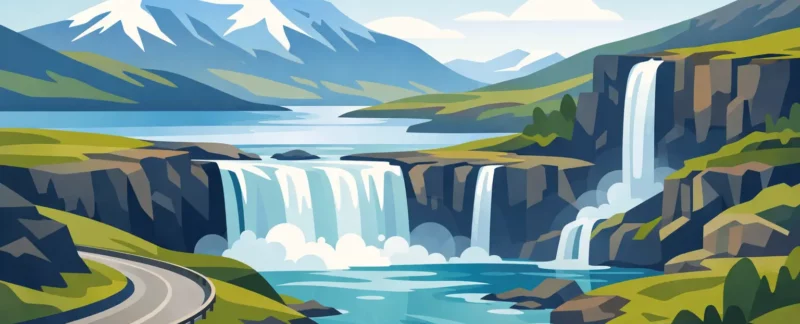
Akureyri is a comfortable base with good restaurants, a harbor, and a surprisingly short distance to some very wild country. The best waterfalls near Akureyri range from a broad, easy-to-reach river fall to powerful canyon waterfalls that require a full day, good weather, and a sensible approach to driving. The right choice depends less on a ranking and more on how much time you have, the season, and whether you want an easy walk or a proper North Iceland adventure.
The Best Waterfalls Near Akureyri
Goðafoss: the essential first stop
Goðafoss is about 35 miles east of Akureyri on Route 1, making it the most straightforward major waterfall visit from town. It is wide rather than towering, with the Skjálfandafljót River splitting into several curtains as it drops over the rock ledge. Even people who have seen plenty of waterfalls tend to stop for longer than planned here.
The waterfall also carries a well-known place in Icelandic history. Tradition says that lawspeaker Þorgeir Ljósvetningagoði threw statues of the old Norse gods into the falls around the year 1000, when Iceland adopted Christianity. Whether you come for the story, the photographs, or simply the sound of the river, Goðafoss earns its popularity.
There are viewpoints on both sides of the river. The west side is generally the simpler stop from Route 1 and has the most direct access, while the east side gives a different angle on the individual cascades. In winter, paths can be icy and daylight is limited, so traction devices and a little extra time are worthwhile.
Aldeyjarfoss: basalt columns and blue water
Aldeyjarfoss, roughly 40 miles south of Akureyri, looks entirely different from Goðafoss. The Skjálfandafljót River drops into a narrow gorge surrounded by dark basalt columns, while the water often takes on a striking blue-green shade. It is one of the most photogenic waterfalls in the region, especially when the river is low enough to reveal the shape of the gorge clearly.
Getting there is part of the experience. The final approach is on a gravel road, and conditions vary with weather and maintenance. In summer, a normal vehicle can often reach the parking area, but drivers should still go slowly and check road conditions. Outside the main season, snow and ice can make this a much more serious outing. This is not a waterfall to visit by simply following a map without considering the day’s conditions.
Aldeyjarfoss pairs naturally with the Bárðardalur valley, where open farmland gradually gives way to highland scenery. If you have a full day and enjoy geology, this is a much richer trip than treating the waterfall as a quick roadside stop.
Dettifoss: raw power on the Diamond Circle
Dettifoss is farther from Akureyri, but it belongs on any serious list of North Iceland waterfalls. It is commonly reached as part of a full-day Diamond Circle route, often combined with Lake Mývatn, Ásbyrgi, and other stops depending on the season. The waterfall is fed by glacial water from Vatnajökull, which gives it its gray-brown color and enormous force.
The point of Dettifoss is not delicate beauty. You feel it before you reach it: the deep, steady vibration underfoot, the spray carried by the wind, and the sound filling the canyon. It is a place that makes people quiet for a moment.
There are access roads on both the west and east sides of Jökulsá á Fjöllum. The west side is usually the more commonly used approach and has a developed walking trail, while the east side can offer a closer, more direct perspective when the road is open. Neither side is automatically better. Road access, wind direction, mobility needs, and your wider itinerary all matter. In wet or icy conditions, stay well back from edges and use marked paths.
Selfoss: Dettifoss’s graceful neighbor
Selfoss is only a short walk upstream from Dettifoss, but it has a completely different character. Instead of one heavy plunge, the river spreads across a long horseshoe-shaped cliff, creating multiple falls around a broad basin. It is lower and quieter in appearance than Dettifoss, though still very much part of the same powerful river system.
If you make the journey to Dettifoss, do not skip Selfoss. The walk adds relatively little time, and many visitors find its shape easier to photograph. It is particularly rewarding when soft light catches the mist or when fresh snow outlines the black lava formations around the canyon.
Hafragilsfoss: the overlooked canyon view
A little farther north along Jökulsá á Fjöllum, Hafragilsfoss drops into a dramatic canyon with fewer visitors than Dettifoss. The waterfall is tall and forceful, but the broader view is what stays with you: a deep river gorge cutting through layers of ancient volcanic landscape.
This stop is best for travelers who have enough time to slow down rather than rush between famous names. Access is more dependent on road conditions than Goðafoss, and it works best when included with Dettifoss and Selfoss on a longer northeast itinerary. If visibility is poor or winds are strong, the views may be limited, so it is wise to keep expectations flexible.
Hrafnabjargafoss: a quieter waterfall for patient travelers
Hrafnabjargafoss is another waterfall on the Skjálfandafljót River, north of the highland interior. It is broad, energetic, and much less visited than Goðafoss or Aldeyjarfoss. The reward is a sense of space: open land, the sound of fast water, and fewer people competing for the same viewpoint.
This is not necessarily the best choice for a first-time visitor with only one day in Akureyri. Roads can be rough, navigation takes more care, and conditions can change quickly. But for travelers who enjoy quiet routes, landscape photography, or a day built around the less obvious corners of North Iceland, it can be a memorable addition.
Kolufossar: a useful westbound detour
If your route takes you west from Akureyri toward Skagafjörður or the northwest, Kolufossar is a worthwhile waterfall stop in Kolugljúfur Canyon. The falls are smaller in scale than Dettifoss, but the canyon gives the place real atmosphere. Several streams of water tumble into a narrow gorge, and the views are especially appealing in green summer light or autumn color.
It is a better fit for a westbound driving day than for a dedicated Akureyri waterfall route. That is the useful distinction: North Iceland is large, and trying to see every waterfall in one day usually means seeing none of them well.
Choosing a Waterfall Route From Akureyri
For a half-day outing, Goðafoss is the clear answer. Add a relaxed stop in the Lake Mývatn area, a geothermal walk, or time for lunch, and you have a satisfying day without long hours in the car.
For a full day with a mix of paved and gravel roads, Goðafoss and Aldeyjarfoss make an excellent pair. They show two very different sides of the same river system: one broad and historic, the other enclosed by basalt and highland-edge scenery.
For the biggest landscapes, plan a full Diamond Circle day for Dettifoss, Selfoss, and possibly Hafragilsfoss. This route requires more time and more attention to road conditions, particularly from late fall through spring. It is also the route where a local guide can make the day feel less like a checklist, adjusting the order around weather, road access, light, and your interests.
Practical Advice for Waterfall Days
Icelandic waterfalls do not come with controlled viewing platforms everywhere, and that is part of their appeal. It also means good footwear matters. Wear waterproof hiking shoes or boots with grip, bring a waterproof outer layer, and protect cameras and phones from spray. At Dettifoss, wind can turn a dry-looking day into a wet one very quickly.
Do not judge distances by miles alone. Gravel roads, sheep near the road, narrow sections, weather, and frequent photo stops all add time. In winter, a route that looks simple in summer may be inaccessible or unsuitable for visitors who are not comfortable driving on snow and ice.
For a private day built around waterfalls, valleys, geology, and the stories behind the places, Kip can tailor the route to your pace and the conditions rather than asking you to fit a fixed bus schedule. Sometimes the best decision is to skip a difficult road and spend longer at a waterfall that is safe, open, and looking its best that day.
The waterfall that stays with you may not be the largest one. It may be Goðafoss in low winter light, Aldeyjarfoss with no one else on the trail, or the first distant roar of Dettifoss before the canyon comes into view. Leave room in the day for that kind of surprise.