
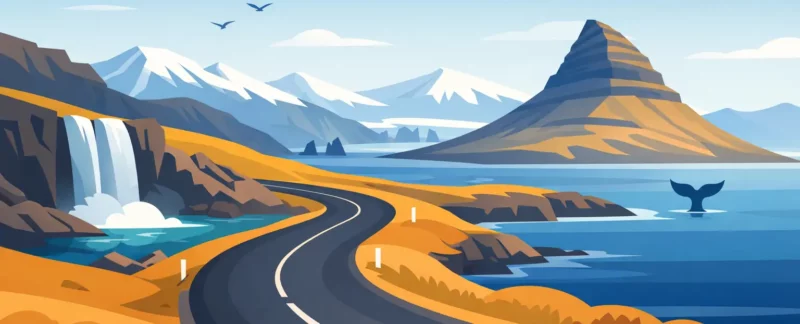
The best scenic drives in North Iceland are not always the ones that cover the most miles. A good day here may mean a slow road beside Lake Mývatn, a detour for a waterfall you almost missed, or a long pause while Arctic terns work the shoreline. The landscape changes quickly, and so do the conditions, which is why choosing the right route for your season and confidence behind the wheel matters.
North Iceland rewards travelers who leave room in the plan. Some routes are easy, paved, and suitable for a relaxed family day. Others lead into highland country where a capable vehicle, weather awareness, and experience are essential. Here are eight drives worth building time around.
1. The Lake Mývatn Circuit
The roads around Lake Mývatn make one of the most varied scenic drives in the region without requiring a demanding day behind the wheel. In a relatively compact area, you can pass lava fields, pseudocraters, steaming geothermal ground, quiet wetlands, and broad views over the lake.
Drive slowly here. The appeal is not the road itself but the frequent stops: Skútustaðagígar pseudocraters, Dimmuborgir lava formations, Hverir geothermal area, and the Krafla region all have very different character. In summer, the light can stay soft late into the evening. In winter, this route can be beautiful but requires more care, as snow, ice, wind, and reduced visibility can change the day quickly.
For travelers based in Mývatn, Laugar, or Akureyri, this is often the best choice when you want a full day of scenery without long transfers.
2. The Diamond Circle to Dettifoss and Ásbyrgi
The Diamond Circle is a classic for a reason. It combines powerful waterfalls, a canyon shaped by glacial floods, a horseshoe-shaped forested valley, and coastal views in one ambitious day. The drive links the Mývatn area with Dettifoss, Selfoss, Húsavík, and Ásbyrgi, though the exact order should depend on your starting point, the weather, and how much walking you want to do.
Dettifoss is the dramatic center of the route. Its volume and force are difficult to understand until you stand near it, feeling spray in the air and the low vibration beneath your feet. From there, the road toward Ásbyrgi shifts the mood completely. The cliffs around the canyon feel sheltered and unexpectedly green, particularly in summer.
This is a long sightseeing day, not a quick loop. It works best when you choose a few stops you genuinely want to experience rather than racing through every marked attraction.
3. Route 85 Along the Tjörnes Peninsula
For open ocean, wide skies, and a quieter feel, take Route 85 around the Tjörnes Peninsula. This road runs north from Húsavík toward Ásbyrgi, following a coastline where the geology is visible in the layered cliffs and the sea is never far away.
The drive is especially rewarding for birdwatchers and photographers. In the right season, you may see seabirds along the cliffs, and the changing weather can make the water look almost metallic. The road is generally straightforward, but winds can be strong and fog can roll in quickly near the coast.
This route is a fine alternative to retracing the same road after a visit to Húsavík or Dettifoss. Give yourself time to stop safely where permitted, rather than treating it only as a connection between larger sights.
4. Route 82 from Akureyri to Hjalteyri and Dalvík
North of Akureyri, Route 82 follows Eyjafjörður, Iceland’s longest fjord. It is an easy, paved drive with a very different character from the volcanic interior. The mountains rise sharply from the water, fishing villages appear along the shore, and the view changes with every bend in the fjord.
Hjalteyri is worth a gentle detour for its old herring-era atmosphere and peaceful harbor. Continue toward Dalvík for larger mountain views and a sense of everyday life in a working north Iceland town. On clear days, the fjord can be remarkably calm. On stormy days, it is a good reminder that this coast is still shaped by the North Atlantic.
It is a practical half-day drive from Akureyri, particularly for travelers who prefer scenic roads with simple logistics and cafés or services nearby.
5. Öxnadalsheiði and the Western Approach to Akureyri
If you are arriving in North Iceland on Route 1 from the west, do not treat Öxnadalsheiði as merely a pass to get through. This stretch between Skagafjörður and Eyjafjörður offers broad valleys, steep mountain slopes, and a fine introduction to the scale of the north.
The scenery is most impressive when low clouds hang around the peaks or when autumn colors begin to show in the valleys. It is also a route where weather can make a meaningful difference. Winter driving may involve icy pavement, drifting snow, and sudden closures, while high winds are possible in every season.
The reward is a gradual arrival into the Akureyri area, with the landscape opening and narrowing in turns. If conditions are poor, there is no shame in changing plans. In Iceland, the sensible route is always the scenic one when it gets you there safely.
6. Route 1 East of Mývatn Toward Möðrudalur
East of Lake Mývatn, Route 1 enters a more spacious and exposed landscape. The road climbs through volcanic highland margins where vegetation thins out and the horizon feels unusually far away. This is not the place for a packed schedule. It is the place for travelers who enjoy emptiness, big weather, and the feeling of being well away from town.
The route toward Möðrudalur is particularly atmospheric in clear conditions, when distant mountains and black volcanic ground seem to go on forever. It can also be challenging in wind, snow, or fog, and services are limited compared with the areas around Akureyri and Mývatn.
Keep fuel levels healthy, check conditions before leaving, and expect the drive to take longer than a map suggests. The scenery is subtle rather than flashy, but it stays with people.
7. Flateyjardalur for a Remote Valley Day
Flateyjardalur is for visitors who want North Iceland beyond the familiar highlights. The valley north of the Mývatn region has a remote, historical feeling, with mountain slopes, old farm landscapes, and very little traffic. It is not a route to take casually in a standard rental car without checking current road conditions.
Access and road quality vary by season. Some approaches are rough, and a suitable four-wheel-drive vehicle may be needed. This is exactly the kind of drive where local knowledge pays off: the best route can change after rain, snowmelt, or road work, and the day should be planned around the conditions rather than a fixed itinerary.
For guests who want quiet photography, local stories, and a true sense of distance from the main road, it can be one of the most memorable days in the north.
8. Askja and the Highland Roads
Askja is among the great scenic drives of North Iceland, but it is not a normal road trip. The journey crosses remote highland terrain toward a volcanic caldera, passing black sand, wide gravel plains, and landscapes that feel almost lunar. The destination is extraordinary, but the drive is a serious part of the experience.
Highland F-roads are only open seasonally and require a proper four-wheel-drive vehicle. River crossings may be involved, and their depth can change quickly. Rental agreements, insurance restrictions, weather, snow cover, and your own river-crossing experience all deserve careful consideration. A two-wheel-drive vehicle does not belong on these roads.
If Askja is high on your list but you do not want the responsibility of a highland drive, a private guided day can make the experience far more relaxed. At Kip, Kristinn plans these kinds of days around current conditions and the interests of the people in the vehicle, rather than forcing a group into a fixed schedule.
How to Choose Among the Best Scenic Drives in North Iceland
The right drive depends less on what looks best in a photo and more on how you want to travel. Choose Lake Mývatn or Eyjafjörður for easy roads and flexible stopping. Choose the Diamond Circle for major natural landmarks and a full day out. Choose Tjörnes or the road east of Mývatn when you enjoy coastal or open-country solitude. Save Flateyjardalur and Askja for days when conditions, vehicle capability, and experience align.
Before any longer drive, check the official road and weather information, fill the tank when you have the chance, and bring warm layers even in summer. Four habits make a noticeable difference:
- Let weather and road reports decide the final route, especially from October through April.
- Build extra time into every day for photo stops, sheep on the road, and changing visibility.
- Stay on marked roads and paths. Fragile moss and volcanic ground can take decades to recover.
- Turn back when conditions worsen. A missed viewpoint is never worth a risky drive.
A scenic drive in North Iceland is at its best when there is time to notice what is between the famous stops: a patch of steam rising from lava, a farmhouse beneath a mountain, or a road disappearing into a valley you had not planned to love.
