
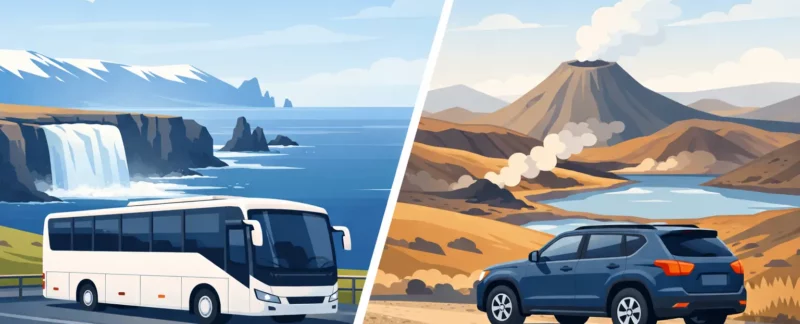
Some trips are easy to plan from a map. North Iceland is not always one of them. A road can look simple online, then turn into a full day of wind, changing light, gravel, and stops you did not know you would want to make. If you are deciding between a guided tour or self drive, the real question is not which option is better in general. It is which one fits the kind of trip you want to have.
For some travelers, driving yourself is part of the fun. You like the freedom, you do not mind adjusting on the fly, and you are comfortable making decisions as conditions change. For others, the best day is one where you can look out the window, ask questions, stop when something catches your eye, and let someone local handle the route, timing, and safety. Both approaches can work well here. The difference is what you want your energy to go toward.
Guided tour or self drive: what are you really choosing?
Most people frame this as independence versus convenience. That is true, but it is only part of the story. In North Iceland, you are also choosing between two very different ways of seeing a place.
A self-drive day often moves faster than expected. You are checking road conditions, watching fuel, looking for parking, keeping an eye on the weather, and deciding whether the next stop is worth the detour. None of that is wrong. It is simply work, even on vacation. On a guided day, that mental load drops away. You spend more time noticing the landscape and less time managing it.
You are also choosing how much context you want. A waterfall is beautiful on its own. It becomes more memorable when you understand how it formed, what people who lived nearby believed about it, how winter changes access, or why a quiet turnoff matters more than the busiest viewpoint. That layer of place is what many travelers miss when they drive themselves, especially on a short visit.
When self-drive makes good sense
If you are confident behind the wheel, comfortable with changing conditions, and happy keeping plans loose, self-drive can be a very good fit. It gives you privacy and control. You can leave early, stay late, skip a stop, or spend an hour with your camera if the light is right.
This option often suits travelers who already enjoy road trips as part of the destination. If you like researching routes, understanding road signs, and accepting that the day may shift because of weather, you may find self-drive rewarding rather than stressful.
It also works best when your route is straightforward and the season is forgiving. A summer day on well-traveled roads is one thing. A shoulder-season day with fog, wind, slick pavement, or reduced daylight is another. Even experienced drivers sometimes underestimate how tiring Iceland can be, not because distances are enormous, but because conditions ask for attention the whole time.
Self-drive can also be limiting in ways people do not expect. The driver cannot fully relax. In a place with wide open views, lava fields, waterfalls, and sudden wildlife, that matters. One person is always working while the other takes in the scenery.
When a guided tour is the better choice
A guided day tends to make the biggest difference when the route is more remote, the weather is unsettled, or you want more than a checklist of stops. It is especially useful if this is your first time in Iceland, if you are traveling with family, or if you simply want the day to feel easier.
North and northeast Iceland have places that are far more enjoyable when you are not the one making every decision. Areas with long distances between services, highland approaches, rougher roads, and shifting conditions can turn a simple outing into something more demanding than expected. That does not mean those places are off-limits. It means they are often better experienced with someone who knows how the day usually unfolds and when to change course.
A private guided tour also gives you flexibility without putting the responsibility on you. That part matters. People sometimes assume a guided trip means fixed timing and a rigid script. In reality, a good private guide adjusts to the group. Some guests want geology, some want folklore, some want quiet scenic time, and some want help finding the best angles for photographs. The day can bend around that.
For older travelers or visitors who would rather not spend their vacation driving, the value is simple. You save your attention for the experience itself. For families, it often means less stress and fewer logistics. For photographers, it can mean reaching the right spot at the right time instead of guessing and hoping.
Guided tour or self drive in different seasons
Season changes this decision more than many travelers realize.
In summer, self-drive is at its easiest. There is more daylight, more room for improvisation, and a lower penalty for taking a wrong turn or moving slowly. If your route stays on easy roads and you enjoy independence, summer is the season when self-drive makes the strongest case.
Winter shifts the balance. Shorter days, snow, ice, drifting wind, and quick weather changes can make even familiar roads feel serious. A route that looks manageable on paper may become tiring or unrealistic once you account for conditions and daylight. In winter, guided travel is often less about luxury and more about making the day practical, comfortable, and safe.
Shoulder seasons sit somewhere in between. Spring and fall can be wonderful, but they ask for flexibility. A morning may start calm and end with poor visibility. Road access can change. Trails can be muddy or icy. These are the months when local judgment quietly becomes very valuable.
What local knowledge changes
The biggest benefit of going with a local guide is not that they know where the famous places are. Anyone can find those. The real difference is judgment.
Local knowledge helps with timing, route order, weather reading, and small decisions that shape the day. It can mean visiting a popular site when it is quieter, choosing a better viewpoint for the light, or skipping a stop that looks good online but is not worth your limited time. It can mean knowing when a valley is sheltered from the wind, when a road is likely to be rougher than expected, or when the best stop is one not marked as a highlight at all.
That is especially true in a region where landscape, history, and geology are tied together. A place becomes richer when someone can explain not only what you are seeing, but why it matters here and to the people who know it as home.
The comfort question people forget to ask
Many travelers focus on cost, freedom, or itinerary. A more useful question is this: how do you want to feel at the end of the day?
If your ideal day ends with the satisfaction of having handled the route yourself, self-drive may be exactly right. If your ideal day ends with good photos, real conversation, less fatigue, and the sense that you understood more than you could have on your own, a guided tour may fit better.
Comfort is not only about the vehicle. It is about decision-making. It is about whether you want to spend your energy navigating or noticing. Neither answer is more adventurous. They are simply different kinds of travel.
A simple way to decide
If your plan centers on easy roads, long daylight, and the pleasure of doing things at your own pace, self-drive can be a great option. If your plan includes remote areas, winter travel, photography goals, family logistics, or a wish to understand the region beyond the surface, a private guided day is often the stronger choice.
At Kip, many guests choose a guided day not because they cannot drive, but because they do not want driving to be the main job of the trip. That is a sensible reason. Iceland asks enough of your attention on its own.
The best choice is the one that lets you enjoy the place in the way that suits you. If you are still undecided, think less about transport and more about what kind of memory you want to bring home. That usually gives you the answer.