
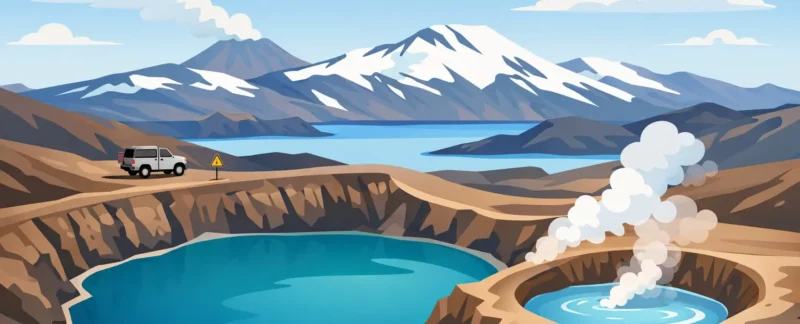
Askja is one of those places that looks calm in photos and feels very different in real life. The road is long, the weather can shift fast, and the landscape gives you very few friendly reminders to turn back before things get complicated. If you are wondering how to see Askja safely, the short answer is this: respect the distance, respect the road, and make decisions based on current conditions rather than your original plan.
That may sound cautious, but Askja rewards cautious travelers. It is one of Iceland’s most striking highland areas, with a volcanic caldera, black deserts, and a feeling of real remoteness that is harder to find in more accessible places. It is also not a casual detour. A good Askja day is built on timing, preparation, and a realistic sense of what highland travel in Iceland demands.
Why Askja needs a different kind of planning
Askja sits deep in the central highlands, and that distance matters more than many visitors expect. This is not just about getting to a viewpoint. You are traveling into an area where road conditions, river levels, fog, wind, and even summer snow can shape the day.
The main mistake people make is treating Askja like any other scenic stop on a ring-road trip. It is not. Even in the open season, the approach roads are rough, the services are limited, and there is much less margin for error if something goes wrong. Cell coverage can be unreliable. Help is farther away. If your plan depends on perfect conditions and tight timing, it is already a weak plan.
That does not mean Askja is only for extreme travelers. It means you need to approach it with the right expectations. Families, older travelers, photographers, and first-time visitors can all enjoy Askja safely, but comfort and safety often come from simplifying the day rather than trying to prove something.
How to see Askja safely by road
For most visitors, the biggest safety question starts before the hike. It starts with the drive. Askja is reached by mountain roads that are usually only open in summer, and road opening dates change from year to year. A road that was open in one July may still be closed the next.
You should never assume access based on a map screenshot, a travel forum post, or a rental contract that sounds vague. Check official road conditions right before departure and again on the morning of your trip. If conditions are uncertain, treat that uncertainty as a warning, not a challenge.
A proper 4×4 is essential for Askja routes. Not a city SUV with hopeful marketing, but a vehicle approved for highland travel. Some approaches include rough surfaces, potholes, loose gravel, and in certain cases river crossings. Whether a road is technically passable does not always mean it is sensible for your experience level.
If you are not used to Icelandic F-roads, Askja is not the place to learn by trial and error. The risk is not only getting stuck. It is misjudging a crossing, damaging the vehicle far from assistance, or arriving so tired that the return drive becomes the real hazard.
This is one reason many travelers choose a guided day trip instead of self-driving. A local guide brings road judgment, weather awareness, and a vehicle suited to the conditions. Just as important, you can spend the day looking out the window instead of gripping the steering wheel and wondering whether the next section is worse than the last.
Weather matters more than your itinerary
One of the safest habits in Iceland is being willing to change the plan. Askja is a very good place to practice that habit.
Highland weather does not care that you booked one specific day months ago. Strong wind can make walking unpleasant or unsafe near exposed sections. Fog can flatten the landscape and reduce visibility. Rain can make the hike slick and make the road slower. Early or late in the season, snow patches can linger longer than people expect.
If you want to know how to see Askja safely, start by asking a better question: should I go today at all? Sometimes the safest and smartest answer is no. That is not a ruined trip. That is good judgment.
A private guided trip is especially useful here because the day can be adjusted around conditions. Sometimes that means changing departure time. Sometimes it means combining highland driving with other stops if Askja is not sensible. Flexibility is not just nice service in Iceland. It is part of safety.
The hike from the parking area
Even after the drive, Askja still asks for a bit of effort. From the parking area, there is a walk across uneven terrain to reach the caldera area and the viewpoint over Víti. The trail is not technical in the mountaineering sense, but it is not a paved stroll either.
Good footwear matters. You want sturdy hiking shoes or boots with grip, not smooth sneakers that were comfortable in Reykjavík. The ground can be dusty, rocky, muddy, or slippery depending on recent weather. If you have knee or balance concerns, take that seriously before you go. The route is manageable for many people, but it still requires steady footing.
Bring layers, even on a mild day. A hat and gloves are not overcautious in the highlands. Neither is water. People often underestimate the walk because the destination is so famous, but famous places can still be physically demanding when they are this remote.
Pacing matters too. There is no prize for rushing to the rim. Walk steadily, stop when you need to, and save energy for the return. I often find that travelers enjoy Askja more when the day is allowed to breathe a little. The place has space in it. You do not need to race through it.
Timing, daylight, and energy
Askja is best done with plenty of daylight and no pressure to hurry back. In summer, that is easier in Iceland than in many places, but long daylight can fool people into overcommitting. Just because the sun is still up does not mean your concentration is.
The drive can be tiring even for experienced travelers. Gravel roads demand attention, and long remote stretches can wear you down. If you are self-driving, be honest about how you handle fatigue. If you have already driven a lot the previous day, Askja may not be the right addition.
This is another reason a dedicated day works better than trying to squeeze Askja into a broader circuit. The safest version of the trip is usually the least rushed one.
What to bring for a safe Askja trip
You do not need expedition gear, but you do need the basics done properly. Warm layers, a waterproof outer layer, solid footwear, water, and food are the essentials. A fully charged phone helps, though you should not depend on coverage.
It is also wise to tell someone your plan if you are going independently. In remote areas, that simple step matters. If you are traveling with children or older family members, extra snacks, warmer layers, and a realistic pace make a big difference to everyone’s day.
Photographers often ask whether they can carry full camera kits on the walk. Usually yes, but only if it does not compromise your balance or energy. Askja is beautiful in all kinds of light, but a safe footing is worth more than one extra lens.
When a guided trip is the safer choice
Some travelers are very capable on rough roads and comfortable reading conditions. Others are excellent travelers but simply do not want the stress of highland driving. There is no shame in that. In fact, it is often the wiser call.
A guided Askja trip makes the most sense if you are unfamiliar with Icelandic roads, traveling with family, hoping for local context, or wanting the day adapted to your pace. It also helps if you are staying in the north and would rather spend your time learning about the landscape than second-guessing every road sign and river crossing.
For a place like Askja, local knowledge is not just storytelling. It is knowing when conditions are normal, when they are not, and what a sensible backup plan looks like. That is where a private guide can change the day from stressful to memorable. At Kip, that is very much the point of the experience.
How to see Askja safely and still enjoy it
Safety at Askja does not mean turning the trip into a checklist of worries. It means giving yourself the best chance to be present once you are there. When the road, weather, and walking plan are handled well, Askja feels less intimidating and more like what it should be: one of Iceland’s most extraordinary volcanic landscapes.
Go on a day that makes sense. Wear what the highlands require, not what looked good in the forecast app. Leave room for the unexpected. And if the trip feels like too much to manage on your own, let somebody local take that weight off your shoulders. Askja is remote, but it does not have to feel uncertain when you approach it the right way.