
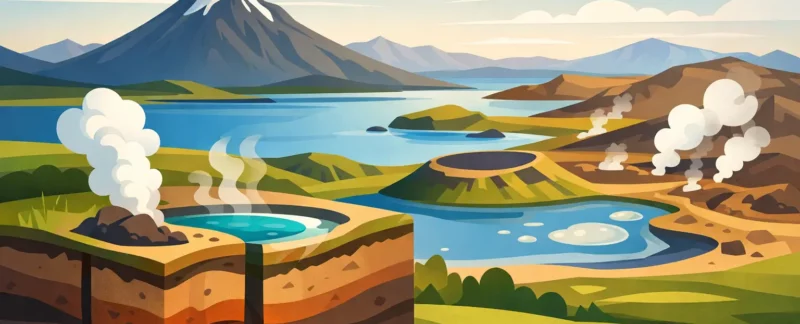
You do not need to be a geologist to feel that Mývatn is different. The ground hisses, the lava looks freshly torn open even when it is centuries old, and one short drive can take you from pseudocraters to steaming vents to a volcanic fissure that changed Iceland’s history. If you are wondering how to explore Mývatn geology in a way that makes sense rather than just checking stops off a map, the best approach is to read the landscape in layers.
This is one of those places where the scenery is not random. Every crater rim, lava shape, and patch of sulfur-stained earth belongs to a story about fire, water, ice, and time. The area rewards curiosity, but it also rewards pacing yourself. If you rush, Mývatn can feel like a string of roadside attractions. If you slow down, it starts to feel like a living textbook written by volcanoes.
How to explore Mývatn geology without rushing it
The mistake many visitors make is trying to see everything as separate sights. In reality, the geology around Mývatn works best when you group places by process. Start with features formed by lava and water, then move to active geothermal areas, and finish with larger volcanic systems that help explain the scale of what you are looking at.
That order matters because it gives you a framework. First you see how lava met wet ground and shallow lakes. Then you see what happens when heat remains close to the surface. After that, broader landscapes like fissures and calderas feel less abstract.
If you have only half a day, focus on Skútustaðagígar, Dimmuborgir, and Hverir. Those three stops alone explain a surprising amount. If you have a full day, add Krafla and Leirhnjúkur. If you have more time, slow the pace and revisit one or two sites in different light. Mývatn changes character with weather and time of day more than many first-time visitors expect.
Start with water and lava at the lake
The pseudocraters at Skútustaðagígar are one of the best places to begin. They look like volcanic craters, but they were not formed by eruptions that blasted material up from a vent. Instead, hot lava flowed over wetlands or shallow water, steam built up underneath, and the surface exploded from that pressure. It is a good introduction because it immediately teaches an important lesson about Mývatn geology – not every crater is a true crater.
That small distinction changes how you see the whole area. Lake Mývatn itself exists in a volcanic setting shaped again and again by lava flows, explosions, and shifting terrain. The pseudocraters show that water has been just as important as magma in creating the landscape.
This is also an easy place to walk and get your eye in. You are not dealing with a huge climb or technical terrain, so you can concentrate on form, spacing, and the way the land sits around the lake. For families, older travelers, or anyone easing into the day, it is a kind start.
Read the lava at Dimmuborgir
Dimmuborgir is where many people stop saying, “That’s interesting,” and start saying, “What happened here?” The lava formations are dramatic enough to grab anyone’s attention, but the real value of the site is that it shows how molten rock behaves when gases, cooling, and uneven ground all come into play.
Some of the towers and arches were created when the outer crust of lava cooled while hotter material kept moving beneath or around it. In other places, trapped gases and collapsing surfaces helped shape the strange architecture. The result looks almost built rather than formed, which is part of what makes the area so memorable.
There is a trade-off here. Dimmuborgir is one of the most accessible and popular stops, so it can feel busy, especially in the middle of the day. If you want quiet and better conditions for photography, early morning or late evening is usually far better. The rock textures also stand out more in low-angle light than under flat midday skies.
See active heat at Hverir
If Dimmuborgir shows what lava leaves behind, Hverir shows that the underground system is still very much alive. The mud pots, steam vents, and orange-brown mineral stains are not subtle. You smell the sulfur before you fully see the field, and that is part of the experience. This is geology happening now, not just geology preserved in the past.
Hverir is one of the clearest places to understand geothermal activity in simple terms. Groundwater is heated by shallow magma or hot rock, gases rise, and the surface becomes unstable, acidic, and chemically altered. That is why the ground looks almost painted in places.
It is also where safety matters most. Stay on marked paths. The surface can be thinner and hotter than it appears, and this is not the kind of place to test your luck for a better photo angle. On a windy day, steam can drift quickly and reduce visibility, so even short walks require a little attention.
Go farther into the system at Krafla and Leirhnjúkur
If you really want to understand how to explore Mývatn geology, make time for Krafla. This is not just one stop but part of a wider volcanic system with a caldera, fissure swarms, lava fields, and a history of eruptions that continued into modern times. Suddenly the smaller features around the lake begin to connect.
The Leirhnjúkur area is especially useful because you can walk across young lava and see how raw volcanic ground slowly settles into a landscape. The earth still feels unfinished there. In some sections the rock remains jagged and dark, while in others steam escapes through cracks as a reminder that cooling is still in progress on a geological timescale.
Nearby Víti adds another piece of the story. Its crater and lake make an immediate visual impression, but it also helps explain explosive volcanic events in the Krafla system. Conditions can change quickly with weather, though. Fog, wind, or snow can flatten the view, so flexibility helps. This is one reason private guiding works well in the area – sometimes the smartest plan is simply changing the order of stops to match the day.
Notice what the weather changes
Mývatn geology is not only about rock type or eruption history. It is also about visibility. Rain deepens color in the lava. Low cloud can make steam fields feel more dramatic but can hide larger landforms. Snow simplifies everything and makes volcanic shapes easier to read in some places, harder in others.
That means there is no single perfect season for everyone. Summer gives longer hours and easier access. Fall often brings strong color and softer light. Winter can be beautiful and quiet, but road and walking conditions demand more care. Spring is less predictable, which some travelers enjoy and others do not.
For photographers, this matters a lot. For first-time visitors, it matters in a more practical way. A site that looks straightforward on a sunny afternoon can feel exposed and slippery in wind or ice. Good planning in Mývatn always includes a little humility.
A local approach works better than a checklist
The best way to explore this area is to let one question lead to the next. Why are these craters different from those? Why is one lava field smooth and another broken? Why does steam rise here but not a few miles away? That approach turns a sightseeing day into something much more memorable.
It also helps to accept that not every stop needs the same amount of time. Some places are best understood in fifteen focused minutes. Others deserve a slower walk and a few quiet pauses. There is no prize for collecting the most parking lots in a day.
As someone who knows this region from the inside, I can say that the geology around Mývatn becomes more rewarding when it is explained in plain language and seen in the right order. That is often the difference between a nice day out and a place you will still be thinking about long after the trip ends.
How to explore Mývatn geology comfortably and safely
Wear boots with decent grip, even if the walk looks easy from the parking area. Bring layers because steam fields and crater rims can feel very different from one another, especially with wind. And give yourself permission to do less. Mývatn is not a place to race through.
If driving conditions, winter roads, or route planning feel like a distraction, it can be worth seeing the area with a certified local guide who can shape the day around your pace and interests. Some travelers want the broad overview. Others want the volcanic story in detail. Both are good ways to experience the region.
The useful thing to remember is that Mývatn does not ask for expertise first. It asks for attention. Once you start noticing how heat, water, and lava keep answering each other across the landscape, the whole area begins to speak more clearly.